

MUNICIPAL INTERVENTION IN SOUTH AFRICA - WHY GOVERNMENT CANNOT SIMPLY TAKE OVER A FAILING MUNICIPALITY
When a failing municipality starts to affect operations, cash flow, development timelines or service delivery, most business leaders ask the same question - why doesn’t government simply step in and fix it? In South Africa, municipal intervention is governed by section 139 of the Constitution and related financial intervention mechanisms, not by a swift corporate-style takeover. That legal framework matters to any business exposed to municipal risk, delayed approvals or deteriorating local services.
The instinctive executive question is therefore entirely rational - why can’t National Treasury intervene, stabilise the finances and restore order? Why can’t a Premier dissolve the council, appoint competent administrators and run the municipality properly for a while? Put differently, why can’t the state behave like an impatient shareholder confronted with a subsidiary that has mislaid both discipline and, on occasion, basic hydraulics?
It’s a sensible question. It’s also precisely the moment at which South Africa’s constitutional architecture enters the discussion, adjusts its spectacles and explains - at some length and with some conviction - that local government isn’t a distressed subsidiary awaiting rescue by head office.
Municipal Government Is Not a Subsidiary
To understand why national or provincial government can’t simply march into a failing municipality and take over at will, one must start with the Constitution of the Republic of South Africa.
Corporate logic suggests a familiar hierarchy - national government as holding company, provincial government as regional management and local government as the branch office. That analogy is intuitively attractive but legally wrong.
Chapter 7 of the Constitution establishes three distinctive, interdependent and interrelated spheres of government. The deliberate use of “spheres”, rather than “tiers”, matters. Municipalities aren’t merely administrative extensions of Pretoria or the provinces. They enjoy original constitutional authority to govern local affairs.
A municipal council is therefore not an outpost of national government. It’s a democratically elected body with constitutionally protected legislative and executive powers, including the power to budget, levy rates and govern within its functional area. Any provincial or national intervention is, for that reason, exceptional rather than routine. In legal terms, intervention is not ordinary management; it’s a carefully constrained incursion into another constitutionally protected sphere of power.
Support Before Intervention
Before a province reaches for the constitutional heavy machinery, the Constitution requires something less dramatic and far less satisfying to the impatient observer - support.
Section 154(1) obliges national and provincial government to support and strengthen the capacity of municipalities to manage their own affairs, exercise their powers and perform their functions. In other words, the Constitution expects assistance before punishment.
In practice, section 154 is the public-law equivalent of a mandatory performance-improvement process - technical support, training, guidance, oversight, frameworks, workshops and the occasional memorandum expressing deep institutional concern. It may not satisfy an executive appetite for decisive intervention, but it is constitutionally important because a province that moves too quickly to coercive intervention without first showing meaningful support invites legal challenge.
That’s not merely a theoretical objection. Parliamentary and policy material on municipal interventions repeatedly shows that procedural failure, weak prior support and political instability can undermine both the effectiveness and lawfulness of intervention measures. For business, the practical consequence is sobering - the system is designed to be lawful before it is fast, and deterioration can persist long after commercial patience has expired.
What Section 139 of the Constitution Really Allows
When support measures fail and a municipality moves from dysfunction to outright governance crisis, the provincial executive may invoke section 139 of the Constitution.
In public discourse this is often described as placing a municipality “under administration”. To commercial ears, that sounds reassuringly like business rescue - a specialist arrives, takes control, imposes discipline and begins cutting costs with the brisk efficiency of a grim but competent turnaround officer. The legal reality is significantly more constrained.
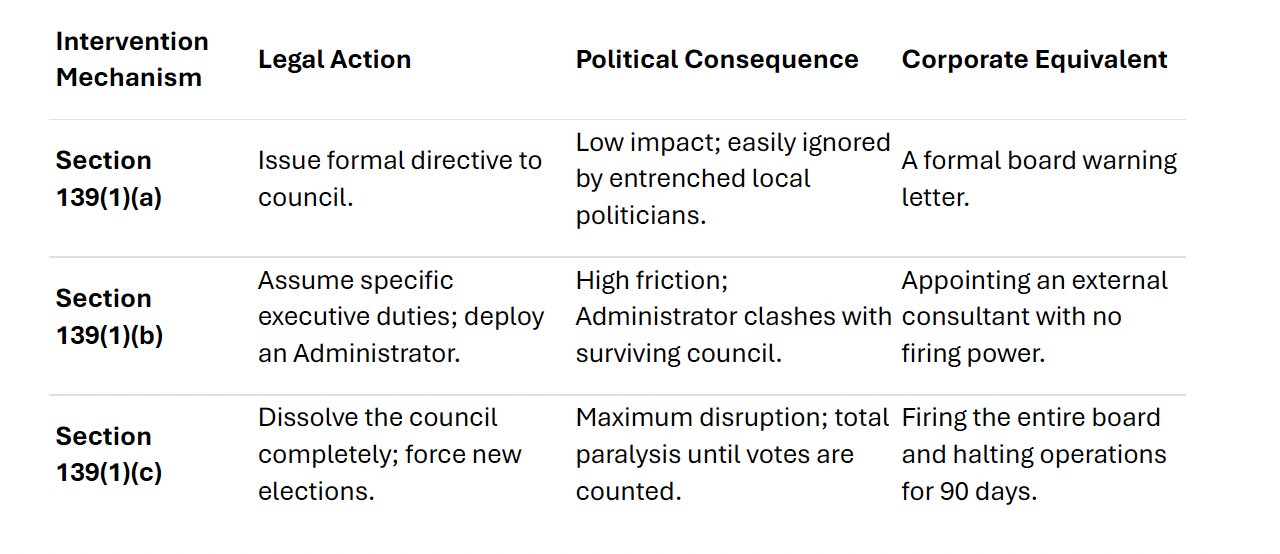
Section 139 is therefore less a constitutional flamethrower than a graduated set of remedial mechanisms, each with its own legal threshold, political cost and practical limitations -
a) Section 139(1)(a): the sternly worded constitutional directive - the provincial executive issues a formal directive identifying the executive failure and instructing the municipality how to remedy it. It is, in substance, a constitutional warning letter - serious in form, limited in practical effect, and often less transformative than its tone suggests.
b) Section 139(1)(b): assumption of responsibility - or, as close to a takeover as the Constitution allows - if the directive fails, the province may assume responsibility for the relevant executive obligation to the extent necessary to maintain essential standards, prevent economic prejudice or preserve national standards. This is typically the point at which an administrator is appointed. The limits matter. The administrator doesn’t become the undisputed sovereign of the municipality. The council usually remains in place, political office-bearers often remain in place, and the administrator is expected to repair a failing function while operating inside an institution that may be politically fractured, administratively weak and openly resistant. It’s less a clean takeover than a constrained intervention carried out in a room where several people are still arguing about who moved the chairs.
c) Section 139(1)(c): the nuclear option. Dissolution of council, sometimes described with more enthusiasm than caution - if exceptional circumstances justify it, the province may dissolve the council and appoint an administrator pending fresh elections. This is the most aggressive intervention available, but it’s also the most politically disruptive and legally scrutinised.
For business, dissolution rarely feels like a neat reset. It often creates a period of uncertainty in which approvals stall, contracts drift, accountability blurs and long-term planning becomes harder. The theory is decisive intervention. The lived experience can feel more like institutional suspension with added paperwork.
The Constitutional Court underscored those limits in Premier, Gauteng and Others v Democratic Alliance (2021), where the decision to dissolve the City of Tshwane council was set aside. The Court made it clear that dissolution under section 139(1)(c) is a measure of last resort directed at genuine executive failure, not a convenient constitutional shortcut through political deadlock.
When Financial Intervention Becomes Mandatory
The position changes materially when the municipality is not merely administratively weak, but financially non-functional - where budgets can’t be passed, revenue measures fail, or material financial obligations can’t be met.
In those circumstances, sections 139(4) and 139(5) of the Constitution, read with Chapter 13 of the Municipal Finance Management Act (MFMA), move the matter from discretion towards obligation. If a municipality cannot approve a budget or revenue-raising measures or is in serious or persistent material breach of its financial commitments, intervention and a financial recovery process are no longer optional policy preferences; they become constitutional duties.
Where provincial inaction persists, national government may intervene under section 139(7). The Free State litigation concerning Mafube Local Municipality illustrates the point - the courts were prepared to compel intervention where prolonged municipal collapse and provincial inertia had become legally untenable. The lesson for executives and lawyers is simple enough - once the statutory triggers are met, inactivity higher up the chain is not insulated from judicial scrutiny.
Even then, however, law cannot repeal arithmetic. A financial recovery plan imposed on a municipality with a collapsing revenue base, chronic non-payment, infrastructure failure and sustained economic decline may be legally necessary while remaining commercially bleak. One may draft an elegant recovery plan. But one cannot invoice optimism.
Section 216(2) of the Constitution and Municipal Financial Intervention
If section 139 is the constitutional framework for municipal intervention in South Africa, section 216(2) of the Constitution is National Treasury’s most severe financial lever. It allows Treasury to withhold funds when a municipality commits a serious or persistent material breach of prescribed financial-management measures, making it a powerful form of municipal financial intervention rather than a general power to take over local government.
To an executive audience, this can sound like the purest form of accountability - if the institution won’t comply, stop the money. Yet public finance has a stubborn habit of being less cathartic than it appears from a distance.
When Treasury halts transfers to a failing municipality, the municipality doesn’t suddenly become prudent. More often, it becomes insolvent in slow motion - suppliers go unpaid, essential inputs are delayed, maintenance is deferred again, and fragile service-delivery systems deteriorate further.
That is the section 216(2) paradox. It may discipline the political centre of the municipality, but it can also intensify the very operational collapse that harms residents, creditors and local businesses. It’s a powerful compliance tool, not a magic repair kit.
What This Means for Business
The practical position is straightforward - when a municipality is failing, business leaders often expect a swift, top-down solution from provincial or national government. The Constitution doesn’t work that way. Instead, it creates a cautious, staged intervention framework that protects municipal autonomy even when performance is visibly deteriorating. For executives, that means planning for legal complexity, delay and commercial risk rather than assuming that government will step in quickly or decisively. So -
· Insist on early statutory compliance and oversight - engage through organised business structures, industry bodies, formal representations and, where necessary, public-law channels to press provinces to discharge their monitoring and support obligations before dysfunction hardens into collapse.
· Approach intervention litigation with precision - litigation aimed at compelling intervention can be effective, but only where the statutory and constitutional triggers are properly evidenced. The case must be built on the legislation, the facts and the procedural history, not merely on understandable commercial exasperation.
· Protect commercial exposure contractually - if your business supplies or contracts with a distressed municipality, ensure your agreements contain disciplined payment protections, dispute-resolution mechanisms, termination rights and a realistic risk-allocation framework. A future intervention is not a dependable substitute for prudent drafting today.
South Africa’s constitutional framework for local government is principled, sophisticated and, in practical terms, often glacial. For businesses whose operations depend on municipal stability, understanding these limits is not an academic luxury. It forms part of sound governance, disciplined risk management and legally informed commercial strategy.
If your business is managing commercial exposure to a distressed municipality, confronting service-delivery risk, or assessing litigation and regulatory options in relation to local government failure, contact our team at NVDB Attorneys. We advise on the legal, governance and commercial consequences of public-sector dysfunction with a clear focus on practical outcomes.
We are a law firm that considers honesty core to our business. We provide clear advice and smart strategies, always keeping your best interests at heart.
(Sources used and to whom we owe thanks - The Constitution of the Republic of South Africa, 1996; the Municipal Finance Management Act; Premier, Gauteng and Others v Democratic Alliance and Others; the Parliamentary Budget Office brief on sections 139 and 154 municipal interventions; provincial intervention records; and official intervention material published by COGTA).