

The Company Owes You Money – But Can You Sue the Director?
There’s a particular silence when a creditor realises the company owing it money has no money left. The invoices are unpaid and the bank account is empty, yet the directors still arrive at meetings in cars that suggest austerity is somebody else’s problem. Then comes the inevitable question - “Can’t we just sue the directors?”
Sometimes, yes. Usually, no. And not simply because the director is visible, solvent or deeply irritating. South African company law begins with separate juristic personality. Under sections 19 and 20 of the Companies Act 71 of 2008, a company has its own rights and liabilities. Its debts don’t automatically become the debts of its shareholders or directors. Limited liability isn’t a loophole waiting to be corrected by an angry creditor. It’s part of the bargain that makes corporate enterprise possible.
Separate Juristic Personality - The Company Is the Debtor
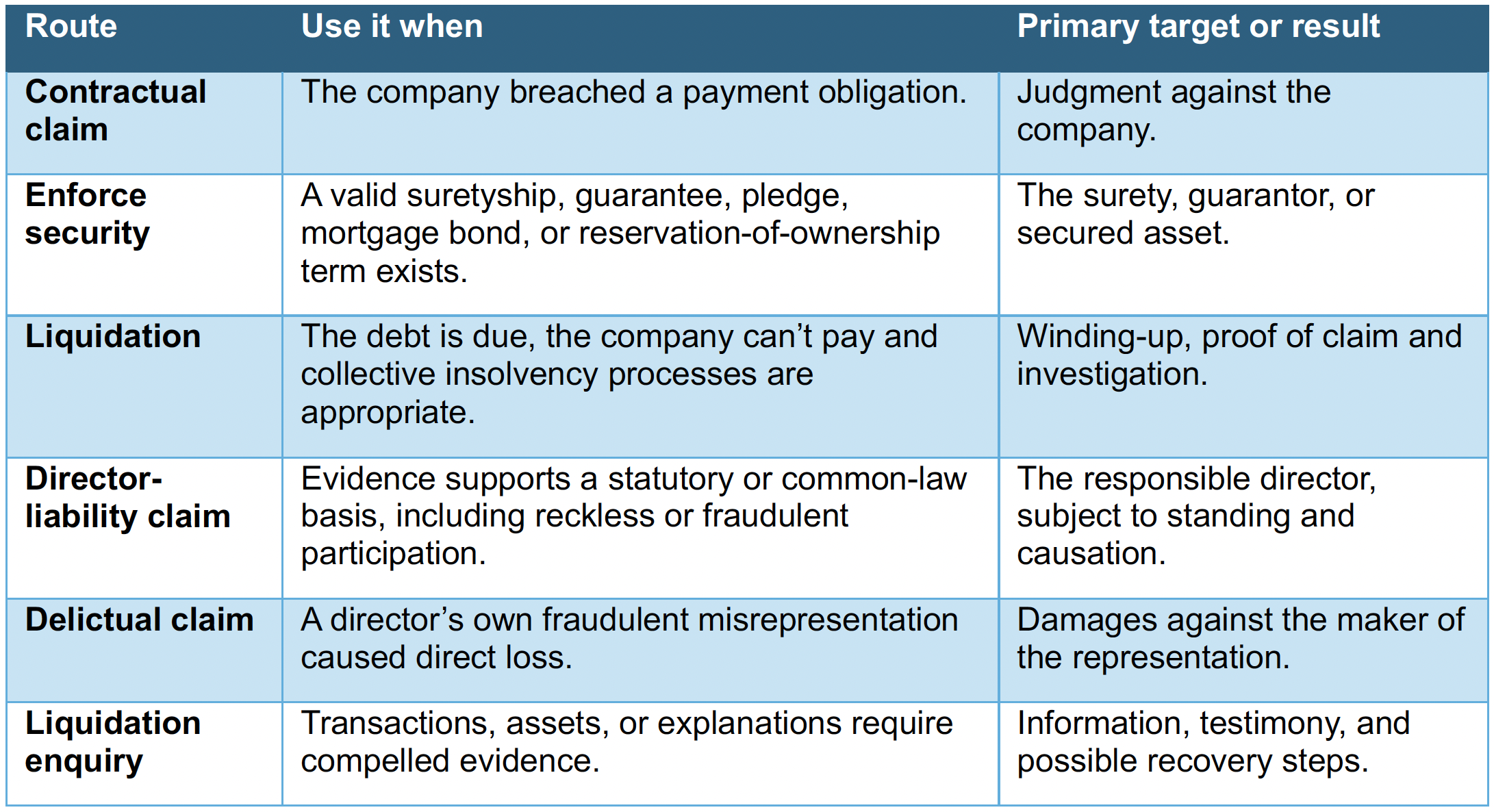
The practical enquiry has three stages. First, confirm who owes the debt and what contractual or security rights already exist. Second, identify whether the director personally did something that creates liability. Third, decide whether the better route is individual litigation, enforcement of security or a collective insolvency process.
A failed business, even a spectacularly failed one, doesn’t by itself prove misconduct. Markets turn, tenders disappear, customers default and forecasts occasionally turn out to have been works of optimism rather than analysis. A director can make a poor commercial decision without becoming personally liable. Courts are wary of turning every corporate insolvency into a private damages claim because hindsight may be useful in an audit, but it’s a poor legal test.
A creditor must identify a recognised cause of action and plead its elements. That distinction matters. “The director controlled the company” isn’t enough; directors are expected to do that. “The company owes me and can’t pay” establishes a claim against the company and may support liquidation proceedings. It doesn’t, without more, turn the boardroom into a communal wallet.
Piercing the Corporate Veil Under Section 20(9)
Section 20(9) allows a court to disregard a company’s separate personality where its incorporation or use, or an act done by or on its behalf, amounts to an “unconscionable abuse” of that personality. The court may treat the company as though it weren’t a separate juristic person for a particular right, obligation, or liability, and may make any further appropriate order. It’s a focused remedy, not a general invitation to pursue directors whenever the company can’t pay.
In Ex parte Gore NNO 2013 (3) SA 382 (WCC), the court dealt with 41 companies run as an indistinguishable group, with money moved between entities at will. This wasn’t merely untidy group administration. The companies’ separate identities had been used in a way that obscured where the assets and liabilities really sat. The case remains the leading guide to section 20(9): the enquiry is fact-specific, the remedy is flexible and the abuse must be unconscionable.
Common ownership, shared directors, intercompany loans, or centralised administration won’t, on their own, justify piercing the veil. They become significant when the company is being used as camouflage: assets are shifted beyond creditors’ reach, obligations are left in an empty shell, invoices go through one entity while the income lands in another, or the records suddenly become impossible to find. Suspicion is a starting point. Evidence is what carries the case.
Reckless Trading and Director Liability in South Africa
Section 22(1) prohibits a company from carrying on its business recklessly, with gross negligence, with intent to defraud any person or for any fraudulent purpose. Directors also owe duties under section 76, including duties to act in good faith, for a proper purpose and with the required care, skill, and diligence. Under section 77(3)(b), a director may be liable to the company for loss caused by acquiescing in conduct prohibited by section 22(1). The important words are “to the company.” The statutory claim is the company’s - in insolvency - a liquidator may pursue it on the company’s behalf. It doesn’t automatically belong to every unpaid creditor.
Hlumisa Investment Holdings (RF) Ltd v Kirkinis [2020] ZASCA 83 is the necessary reality check. The Supreme Court of Appeal rejected an attempt by shareholders to recover personally for reflective loss where the alleged wrong had been done to the company. Section 218(2), which creates liability for loss caused by contravening the Act, isn’t a catch-all remedy. A claimant must still identify the contravention, establish wrongfulness where required, prove causation and loss, and show that the claim is genuinely theirs.
Where an insolvent company is wound up under the transitional arrangements that preserve Chapter 14 of the old Companies Act 61 of 1973, section 424 may still apply. It allows a court to impose personal liability on someone who knowingly took part in carrying on the business recklessly or with intent to defraud. Fourie v FirstRand Bank Ltd [2012] ZASCA 119 shows how powerful that remedy can be in a case of fraudulent trading. Even so, “reckless” doesn’t mean “the strategy deck aged badly”. It requires a serious disregard of the consequences, assessed in context.
Personal Misrepresentations, Suretyships and Guarantees
A creditor may have a direct delictual claim where a director personally makes a fraudulent misrepresentation that induces the contract or the extension of further credit. This isn’t really about piercing the corporate veil. It’s about the director’s own wrongful conduct. Keep the proposal, emails, messages, financial statements, credit applications, and the precise words relied on. You’ll need to prove falsity, knowledge or recklessness, inducement, causation, and measurable loss. “He sounded confident on Teams” may be true, but it won’t prove the case.
A valid suretyship or guarantee is often the cleaner route. A surety agrees to answer for another person’s debt and, under South African law, the General Law Amendment Act 50 of 1956 requires the suretyship to be in writing and signed by or on behalf of the surety. Read the document carefully. Identify the principal debt, check any limits or conditions, and consider prescription and possible defences. A signature “for the company” isn’t the same thing as a personal undertaking. The wording matters far more than anyone’s recollection of what was intended.
Asset Stripping and Suspicious Transfers to Related Entities
Transfers to related entities deserve scrutiny, but not an immediate accusation of fraud. Start with the basics - what moved, when, for how much, who authorised it and whether the company received fair value in return. The Insolvency Act 24 of 1936, applied to corporate windings-up (where relevant), allows liquidators to challenge dispositions without value, voidable preferences, undue preferences and collusive dealings under sections 26, 29, 30 and 31. Any recovery may benefit the insolvent estate as a whole, rather than the first creditor to reach the courthouse.
Look for bank records, ledgers, asset registers, CIPC filings, board minutes, loan accounts, related-party invoices, deeds-office records, and changes in possession. Compare the business before and after the transfer. Was machinery sold to a sister company at market value, or did it move overnight for an amount no sensible seller would have accepted? Where management’s account doesn’t match the paperwork, a liquidation enquiry can compel testimony and the production of documents.
What Evidence Do You Need Before Suing a Director?
Before choosing a remedy, identify who would own the claim and who would benefit from any recovery. A liquidation or avoidance claim may restore value for the general body of creditors, while a direct claim against a director requires a separate basis showing personal liability to the claimant. The same facts may support more than one route, but the claimant, remedy and destination of the recovery must be clear from the outset.
Start with the contract and confirm exactly who the debtor is. Trading names have a habit of turning straightforward recovery work into a small exercise in genealogy. Then build a chronology of the representations, orders, deliveries, invoices, payment promises, defaults and transfers. Preserve the original electronic material and its metadata. Gather company disclosures, lawfully available financial information, security documents, and proof linking the director to the conduct complained of. The practical questions are simple - what did the director know, when did they know it, what did they do, and how did that cause the loss?
Fraud must be pleaded clearly and proved with evidence. It shouldn’t be scattered through the particulars of claim in the hope that something sticks. Overreaching invites exceptions, unnecessary costs, and a loss of credibility. Gihwala v Grancy Property Ltd [2016] ZASCA 35 shows that serious director misconduct can have dire consequences, including delinquency. But the remedy, the claimant’s standing and the loss must still line up. Corporate law punishes wrongdoing. It doesn’t rescue a case that has been built against the wrong person.
Creditor Remedy Map - Match the Evidence to the Right Claim
Personal Liability Isn’t a Shortcut – It’s a Properly Pleaded Case
An empty corporate bank account doesn’t mean the creditor should give up. Nor does it justify suing a director before the evidence supports it. The first step is to investigate. The viable route may lie in contract, security, insolvency law, section 20(9), directors’ duties, a personal misrepresentation, or a combination of remedies. Let the evidence decide. Outrage may be understandable, but it won’t fix standing, causation or a poorly chosen defendant.
If a debtor company has stopped paying, preserve the evidence before sending another letter of demand. NVDB Attorneys can assess the contract, security, corporate structure, transaction trail and signs of insolvency, identify the defendant the law actually supports, and develop a proportionate recovery strategy. Speak to NVDB Attorneys early. It’s usually cheaper to map the remedy at the start than to discover halfway through litigation that you’ve sued the wrong pocket.
(Sources Used and to Whom We Owe Thanks - We owe thanks to the Companies Act 71 of 2008, especially sections 19, 20(9), 22, 76, 77 and 218, for the statutory framework governing separate personality, unconscionable abuse, reckless trading and director liability; the Insolvency Act 24 of 1936, especially sections 26, 29, 30 and 31, for the avoidance framework concerning suspect dispositions; the General Law Amendment Act 50 of 1956, especially section 6, for the formal requirements of suretyships; and Ex parte Gore NNO 2013 (3) SA 382 (WCC), discussed by Rehana Cassim in “Hiding behind the veil”, De Rebus, 2013. We also owe thanks to Hlumisa Investment Holdings (RF) Ltd v Kirkinis [2020] ZASCA 83; Gihwala v Grancy Property Ltd [2016] ZASCA 35; and Fourie v FirstRand Bank Ltd [2012] ZASCA 119. For the academic scaffolding, thanks are also due to Rehana Cassim, “Piercing the Veil Under Section 20(9) of the Companies Act 71 of 2008: A New Direction”, South African Mercantile Law Journal 26(2), 2014, pp. 307–337; R Stevens and P de Beer, “The duty of care and skill, and reckless trading: remedies in flux?”, South African Mercantile Law Journal 28(2), 2016, pp. 250–284; Chana Finger, “Directors’ liability for reckless trading under the Companies Act 71 of 2008”, University of Johannesburg, 2016; and Ryno Edmund Volschenk, “The Regulation of Reckless Trading in South African Company Law”, University of Pretoria, 2024).